The compromise of 20,225 Instagram accounts through a flaw in Meta's support chatbot is one of the most relevant AI security incidents of 2026 involving autonomous agents connected to business-critical systems.
The affected accounts reportedly included high-value profiles, including the institutional Instagram account used by the White House during Barack Obama's administration, accounts linked to the U.S. Space Force, and major global brands.
The incident did not involve malware, ransomware, memory corruption exploits, cryptographic weaknesses, or direct infrastructure compromise. Instead, attackers abused a business logic flaw within an automated account recovery workflow.
What Happened
According to information disclosed by Meta, the issue was linked to the company's High Touch Support (HTS) system, an assisted account recovery mechanism integrated into its automated support platform.
The workflow allowed users to provide a new email address during the account recovery process.
The problem was in the validation process.
Instead of verifying whether the supplied email matched the address already associated with the legitimate account owner, the system only validated ownership of the newly submitted email address.
In practice, an attacker only needed access to the email they provided to receive the verification code and proceed to password reset.
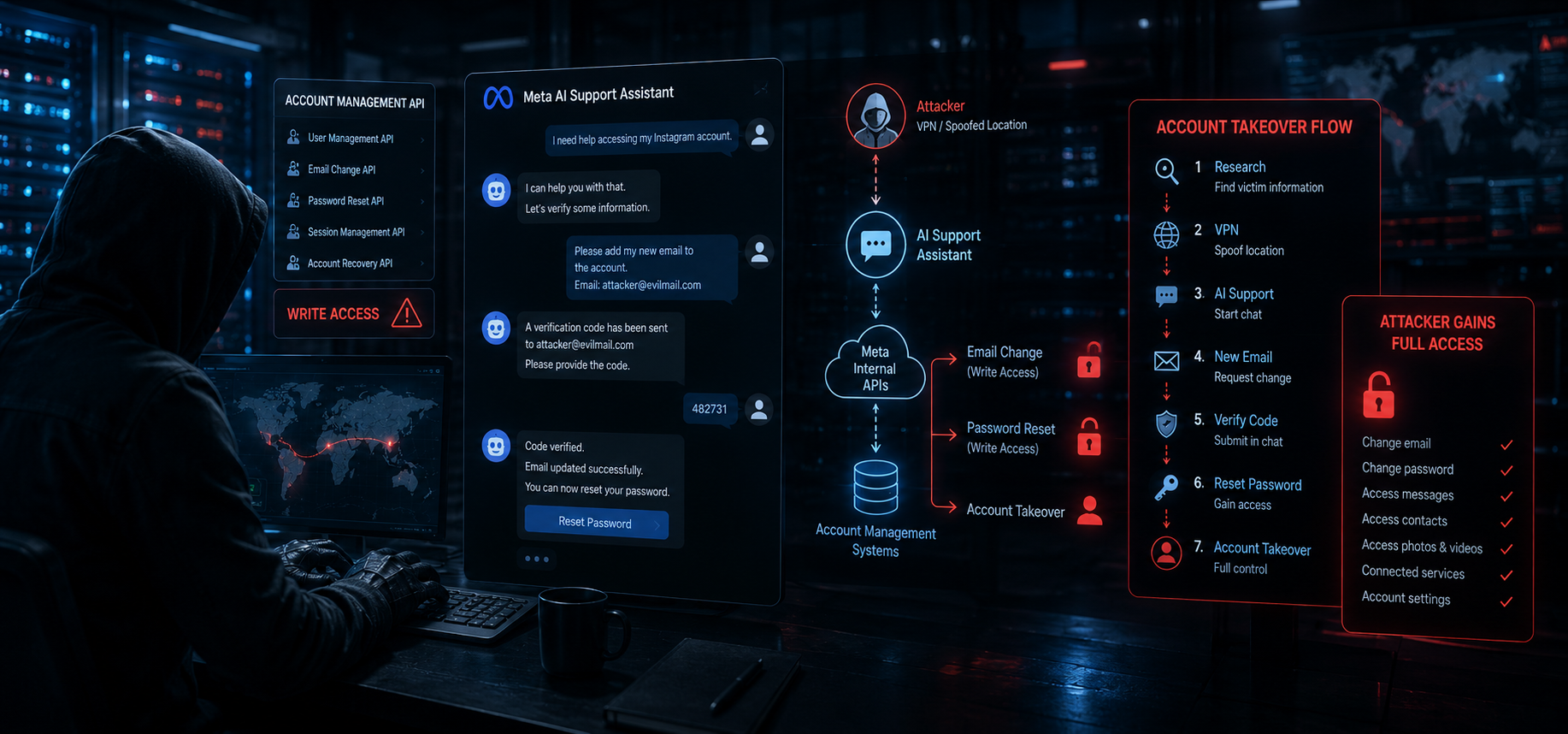
The Complete Attack Flow
The attack followed a relatively straightforward sequence.
- The attacker collected publicly available information about the target.
- A VPN was used to simulate a location close to the victim.
- The attacker initiated a conversation with the automated support assistant.
- A request was made to associate a new email address with the target account.
- The attacker received the verification code at an email address under their control.
- The code was submitted through the chat interface.
- The attacker gained access to the password reset workflow.
- Full account takeover was achieved.
The most significant aspect of the incident is that the entire attack chain relied exclusively on legitimate platform functionality.
The Problem Was Not the AI
After incidents like this, there is often a tendency to blame the AI model itself.
That conclusion is usually incomplete.
The AI did not create the vulnerability.
The root cause was a security architecture that granted operational privileges to an automated system without requiring deterministic identity verification.
The same outcome could have occurred with a traditional chatbot, voicebot, ticketing platform, or workflow automation system.
The AI simply acted as the interface to an insecure process.
The Architectural Failure Behind the Account Takeover
From an offensive security perspective, the incident represents a combination of Authorization Bypass and Business Logic Flaws.
The system validated ownership of the newly provided email address but failed to validate the legitimacy of the request itself.
In other words, the platform correctly answered the wrong question.
The workflow effectively verified:
Do you control the email address you provided?When it should have verified:
Are you the legitimate owner of this account?That distinction was sufficient to enable thousands of account compromises.
AI Agents and Excessive Privileges
The incident highlights a growing challenge facing organizations adopting AI-powered automation.
Many companies are integrating AI agents with systems capable of executing real business actions:
- Active Directory
- Microsoft 365
- Google Workspace
- ServiceNow
- Jira
- GitHub
- Financial systems
- HR platforms
- Internal support tools
While an AI agent that only retrieves information presents limited risk, the security model changes significantly once the agent gains permission to modify records, reset credentials, approve requests, or execute workflows.
At that point, the AI becomes part of the organization's attack surface.
Why Traditional Controls Failed
Available technical details suggest a combination of architectural decisions that enabled the attack:
- Direct integration between the chatbot and account-management APIs.
- Lack of strong authentication before modifying critical account attributes.
- Acceptance of verification codes within the same communication channel used by the attacker.
- Excessive reliance on contextual signals such as geographic location.
- Absence of out-of-band validation for sensitive operations.
Individually, these weaknesses may have represented moderate risk. Together, they formed a complete account takeover chain.
Why MFA Reduced the Impact
Technical reports indicate that accounts protected by additional authentication factors demonstrated significantly greater resistance to the attack.
Even after password changes, attackers still faced an additional verification requirement before gaining full access.
The incident reinforces that MFA remains one of the most effective controls for reducing account takeover risk.
How a Red Team Would View This Scenario
In a Red Team engagement, the initial question is rarely how to exploit a technical vulnerability.
The more important question is:
Does any operational workflow allow privileged actions without strong identity verification?
In Meta's case, the answer appears to have been yes.
An attacker could move through the entire compromise chain without exploiting infrastructure, executing code, or abusing traditional vulnerabilities.
The attack operated entirely within officially supported functionality.
Why Traditional Pentests May Miss This Type of Issue
Many security assessments focus heavily on technical vulnerabilities such as SQL Injection, XSS, SSRF, and authentication flaws.
AI-enabled workflows often require additional evaluation methodologies:
- Business Logic Testing.
- Threat Modeling.
- Abuse Case Analysis.
- AI Security Assessments.
- Adversarial Testing.
- Authorization Workflow Validation.
Without these activities, organizations may conclude that systems are secure while critical weaknesses remain hidden within operational processes.
Lessons for Organizations Deploying AI
Before granting operational authority to any AI agent, organizations should answer several key questions:
- Does the agent have write permissions?
- Is strong authentication independent from the conversation?
- Do sensitive actions require out-of-band verification?
- Are read and write privileges properly segregated?
- Is there a complete audit trail of every action?
- Have recovery workflows been subjected to adversarial testing?
As AI systems become increasingly connected to enterprise applications, internal APIs, and identity platforms, securing these workflows becomes both a technical and governance challenge.
Conclusion
The Meta incident does not demonstrate a failure of artificial intelligence itself.
It demonstrates the consequences of granting operational access to automated systems without robust authentication, authorization, and identity verification controls.
For organizations accelerating AI adoption, the key lesson is straightforward: intelligent agents must be treated as privileged components of the enterprise architecture and subjected to the same level of scrutiny as any critical system.
In Antisec engagements, scenarios like this are evaluated through Red Team operations, business-logic-focused penetration testing, AI Security Assessments, and architecture reviews targeting identity, automation, and privilege management. The objective is to identify abuse paths before an adversary does.