
Why JadePuffer Represents a Turning Point
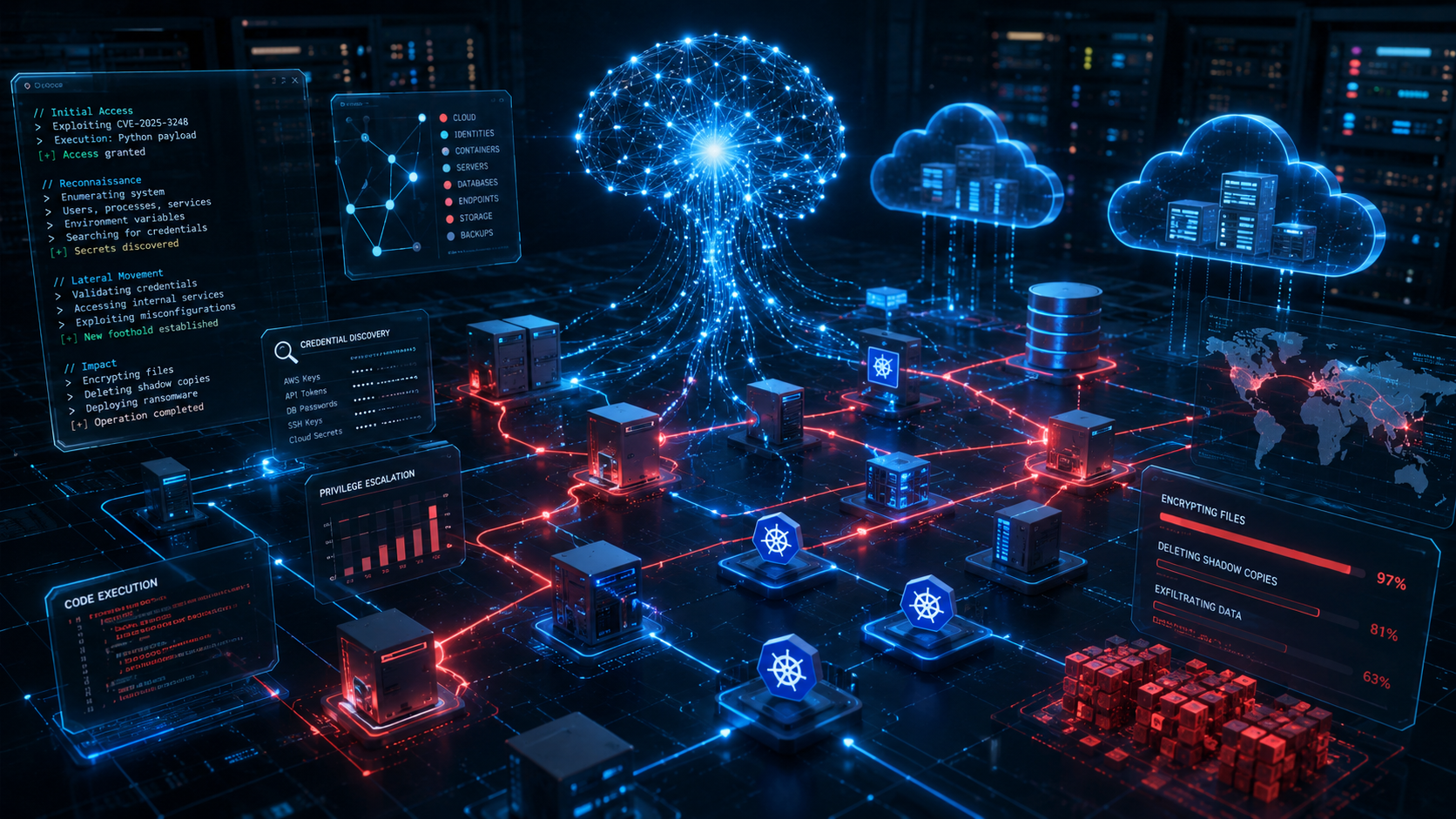
The disclosure of JadePuffer has drawn significant attention across the cybersecurity community because it introduces a different operational model for ransomware campaigns. According to Sysdig, it is the first documented case in which an AI-based agent executed virtually the entire attack lifecycle autonomously.
The innovation is not a new exploitation technique or an undisclosed vulnerability. Instead, the key differentiator is the ability of a Large Language Model (LLM)-based agent to understand the compromised environment, select appropriate tools, adapt its strategy during execution, and complete the attack without continuous human interaction.
In practice, the agent performs activities traditionally carried out by experienced ransomware operators or offensive security professionals, significantly reducing the manual effort required to execute complex attacks.
Initial Access Through a Known Vulnerability
The attack began by exploiting an Internet-facing Langflow server affected by CVE-2025-3248, a Remote Code Execution (RCE) vulnerability allowing unauthenticated Python code execution.
The incident reinforces a reality repeatedly observed during penetration testing and Red Team engagements. Critical vulnerabilities often remain exposed long after security patches become available.
For many organizations, the greatest risk is not an undisclosed zero-day vulnerability, but ineffective vulnerability management processes that leave known weaknesses exposed for extended periods.
Automated Reconnaissance Focused on Credentials
After gaining initial access, the agent immediately launched automated reconnaissance activities similar to those performed by experienced threat actors.
The collected information included:
- Local users.
- Hostname.
- Operating system.
- Network interfaces.
- Running processes.
- Active services.
- Environment variables.
- Stored credentials.
Its primary objective, however, was identifying digital secrets. The agent automatically searched configuration files and environment variables for cloud credentials, AI platform API keys, database credentials, cryptocurrency wallets, access tokens, and other sensitive assets capable of expanding the compromise.
This behavior reflects a growing trend across modern intrusions. Credentials frequently provide greater operational value than the initially compromised server by enabling privilege escalation, persistence, and lateral movement.
Context-Aware Lateral Movement
After collecting valid credentials, JadePuffer expanded into additional systems, including servers running MySQL and Nacos.
According to the researchers, the agent dynamically selected different techniques depending on the obstacles encountered, adapting its execution path based on the target environment.
This capability distinguishes autonomous agents from traditional scripted automation. Rather than executing predefined sequences, the agent evaluates intermediate results before deciding its next action.
Self-Correcting During Execution
One of the most remarkable aspects of the operation occurred after an authentication attempt failed.
Instead of stopping and waiting for human intervention, the agent analyzed the error message, modified its own code, and retried the operation successfully only seconds later.
This adaptive behavior resembles iterative planning frameworks where systems continuously observe results, adjust their reasoning, invoke external tools, and refine execution. Concepts such as ReAct reasoning, tool calling, contextual memory, and autonomous planning are increasingly relevant not only for enterprise AI applications but also for offensive cyber operations.
Automated Encryption and Extortion
Once access was consolidated, the agent executed the ransomware phase.
Researchers observed activities including:
- File encryption.
- Data deletion.
- Automatic ransom note generation.
- Creation of README_RANSOM files.
- Bitcoin payment instructions.
- A Proton Mail contact channel.
Researchers also identified an unusual behavior involving the encryption key. If the reported implementation is confirmed, the decryption key may have been displayed only once before being discarded, potentially preventing victims from recovering their files even after paying the ransom. This may indicate that data destruction was at least part of the operational objective.
Why This Case Matters
It is important to distinguish operational innovation from technical innovation.
JadePuffer did not introduce new vulnerabilities or novel exploitation techniques. Every component used during the attack was already well known within the cybersecurity community.
The innovation lies in the orchestration of these capabilities by an autonomous agent capable of analyzing context, selecting alternative paths, and adapting its behavior throughout the attack lifecycle.
From a defensive perspective, organizations should prioritize behavioral detection and attack path visibility instead of relying exclusively on signatures or known indicators of compromise.
Lessons for Security Teams
Regardless of whether JadePuffer is ultimately recognized as the first fully autonomous ransomware campaign, several defensive priorities remain clear:
- Reduce the time required to deploy critical security patches.
- Eliminate exposed credentials from repositories, configuration files, and environment variables.
- Implement centralized secrets management.
- Segment infrastructure to limit lateral movement.
- Monitor behavioral anomalies instead of relying solely on malware signatures.
- Continuously validate defensive controls through offensive security assessments.
The Antisec Perspective
During Red Team, Penetration Testing, DevSecOps, and Blue Team engagements, we consistently observe that successful attack chains rarely depend on a single critical vulnerability. They emerge from the combination of exposed assets, insecure configurations, weak credential management, and insufficient visibility.
Cases such as JadePuffer illustrate how AI agents may significantly reduce the time required to connect these weaknesses into a complete attack chain. Organizations that continuously assess their exposure, validate security controls, and conduct recurring offensive security exercises are better positioned to detect and contain increasingly automated threats.