
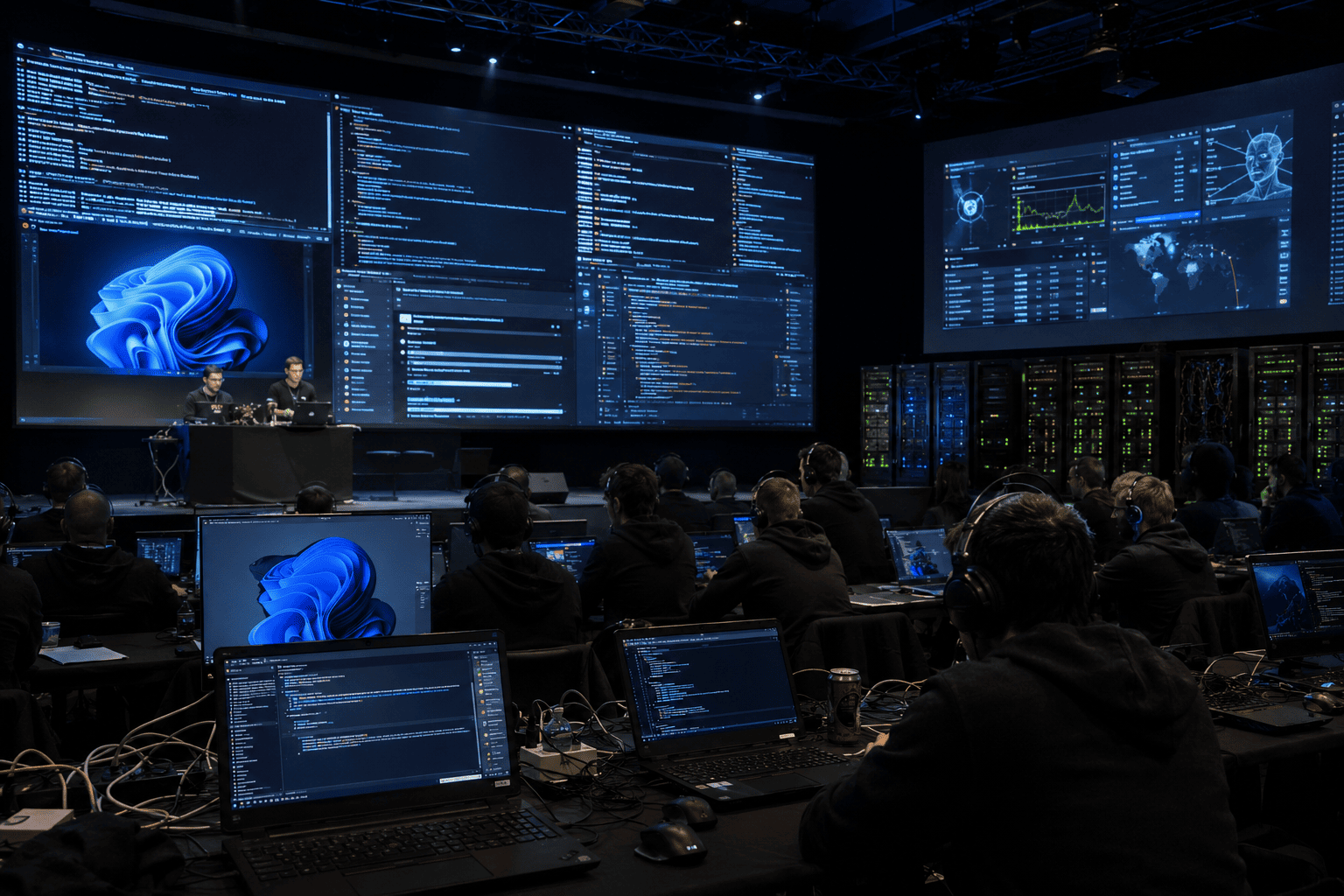
OffensiveCon 2026 reinforced Berlin as one of the leading global hubs for applied offensive security research. Inside the conference, Pwn2Own Berlin 2026 turned practical exploitation into operational intelligence for organizations defending enterprise environments.
In just three days, researchers demonstrated 47 unique zero-days and earned a combined US$1,298,250 in rewards. DEVCORE dominated the competition, taking the Master of Pwn title with 50.5 points and US$505,000 in winnings.
The most important takeaway was not simply the number of exploited vulnerabilities. The event exposed where offensive researchers are finding real technical leverage: AI stacks, virtualization, container infrastructure, enterprise browsers, Exchange and developer runtimes.
OffensiveCon remains a benchmark for offensive research
Unlike generic cybersecurity conferences, OffensiveCon maintains a highly technical profile focused on practical exploitation. The 2026 edition took place in Berlin on May 15 and 16, with advanced training sessions covering kernel exploitation, iOS, baseband and embedded zero-day hunting.
The single-track format keeps the conference tightly focused on applied offensive research, reverse engineering and exploit development. The audience primarily includes exploit developers, vulnerability researchers, Red Team operators and professionals working on deep attack surface analysis.
Pwn2Own expanded into AI and modern infrastructure
Pwn2Own Berlin 2026 was organized by the Zero Day Initiative, Trend Micro's vulnerability research division. This year's edition significantly expanded into modern enterprise technologies.
Beyond browsers and operating systems, researchers targeted AI databases, coding agents, local inference runtimes, NVIDIA products, container stacks and collaboration platforms.
This reflects a major shift in today's attack surface. Offensive focus is no longer limited to browsers and operating systems. AI tools, local inference runtimes, development pipelines and hybrid infrastructure are now part of the same operational risk chain.
Microsoft Edge, Windows 11 and Exchange were heavily targeted
One of the most discussed demonstrations involved a four-bug chain against Microsoft Edge. The exploit achieved sandbox escape and earned Orange Tsai US$175,000.
Windows 11 appeared repeatedly throughout the event in demonstrations involving local privilege escalation and chained exploitation techniques.
On the second day, Cheng-Da Tsai exploited a three-bug chain against a fully patched Microsoft Exchange server. The attack achieved Remote Code Execution followed by SYSTEM-level privilege escalation. The exploit earned US$200,000, becoming one of the most valuable demonstrations of the competition.
The most relevant technical detail was not the individual bugs themselves, but the ability to chain multiple vulnerabilities into privileged code execution. This model closely resembles real-world offensive operations against enterprise environments.
AI tools officially entered the attack surface
Cursor, OpenAI Codex, LiteLLM, LM Studio and other AI-assisted development tools appeared as exploitable targets during the event.
This reinforces a scenario many organizations still underestimate: AI development tools often operate with privileged access to source code, CI/CD pipelines, internal repositories, secrets and automation workflows.
In many environments, these agents run with elevated permissions, GitHub integration, SSH access, internal tokens and local execution capabilities. From an offensive perspective, this creates an extremely valuable surface for lateral movement, credential harvesting and persistence.
In practice, many organizations introduced AI into development workflows without redesigning privilege architecture, segmentation, telemetry and operational isolation.
NVIDIA, containers and isolation failures also stood out
Another major technical highlight involved exploitation targeting NVIDIA ecosystem components and container infrastructure.
Researchers demonstrated attacks against NVIDIA Container Toolkit and Megatron Bridge using vulnerability classes such as Use-After-Free, memory corruption and sandbox isolation bypass.
Containerized environments are often treated as inherently secure because of logical isolation. The problem is that once attackers compromise runtimes, bridges or GPU integrations, that isolation rapidly loses operational value.
In enterprise AI environments, the impact becomes even greater because inference workloads frequently operate in shared clusters with sensitive internal data and elevated privileges.
Linux privilege escalation remains operationally relevant
Red Hat Enterprise Linux for Workstations was also compromised through local privilege escalation techniques.
Although LPE is considered a traditional vulnerability class, it remains highly relevant because real-world offensive operations still depend heavily on chained escalation after initial access.
Modern attacks rarely rely on a single critical vulnerability. The most common pattern combines initial execution, sandbox escape, isolation bypass and privilege escalation until persistence or privileged access is achieved.
What this signals for enterprise security teams
Pwn2Own Berlin 2026 acted as a strong technical indicator of where offensive security research is heading.
AI products, virtualization, enterprise browsers, collaboration software, local runtimes and container infrastructure are now priority targets in modern exploitation research.
That creates immediate operational implications for defenders:
- Review permissions assigned to AI tools and coding agents
- Harden hypervisors and virtualization infrastructure
- Monitor local inference runtimes
- Improve segmentation between critical workloads
- Validate isolation boundaries in containerized environments
- Reduce excessive developer privileges
- Continuously validate exposure through advanced Red Team and Pentest operations
Many organizations still view enterprise AI primarily as a productivity layer. The problem is that several of these components already operate with enough privilege to become high-value offensive vectors.
What appears on the OffensiveCon stage frequently anticipates techniques and targets that later emerge in real-world incidents. For security teams, ignoring those signals usually becomes expensive.