
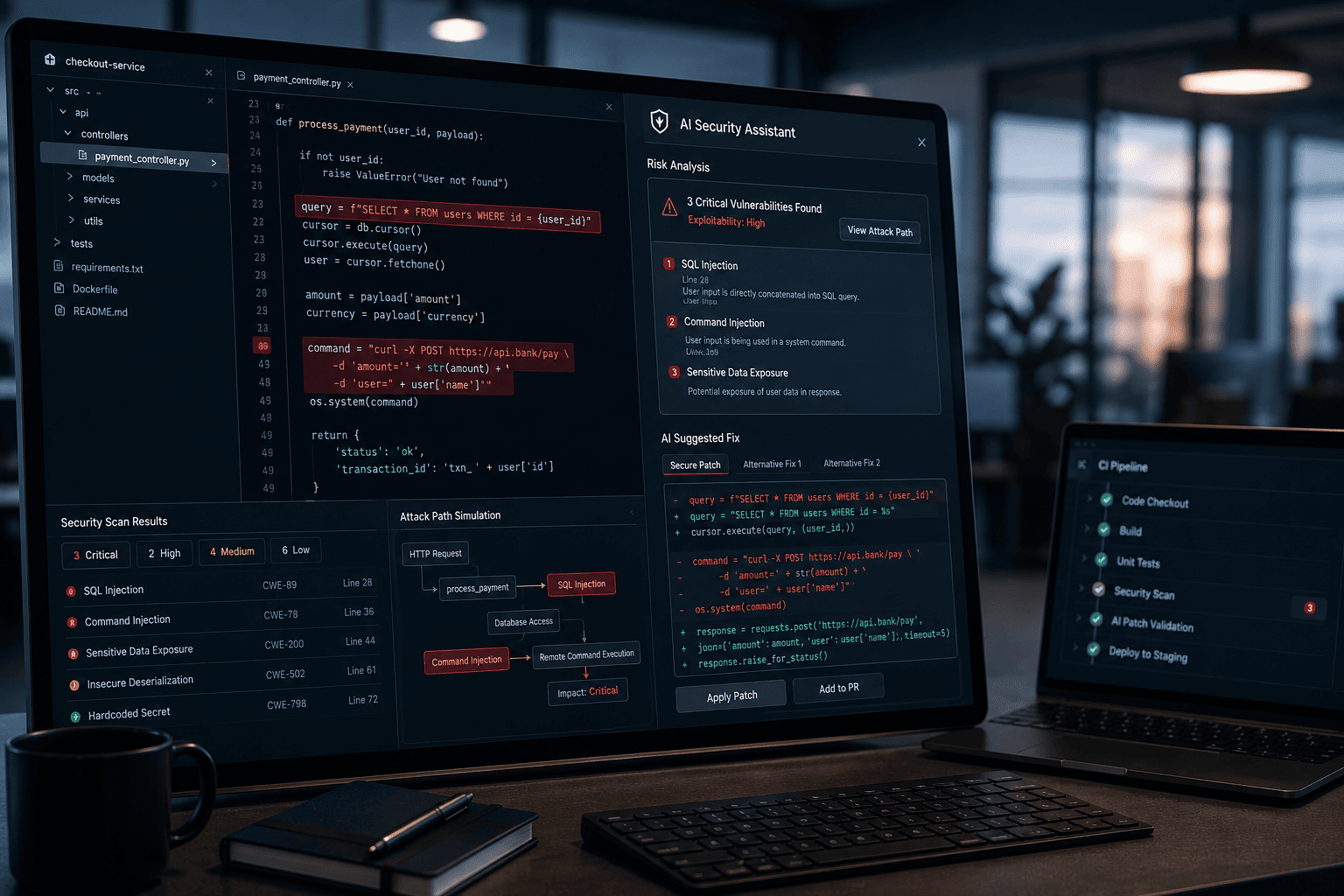
OpenAI officially enters the automated AppSec battlefield
OpenAI announced Daybreak, an offensive and defensive AI security platform designed to identify vulnerabilities, validate exploitability and generate remediation before production deployment.
In practice, Daybreak attempts to bring security directly into real-time software development workflows. The goal is not limited to vulnerability discovery. The platform focuses on contextual risk analysis, exploit simulation and automated patch generation inside development pipelines.
For organizations operating multiple pipelines, microservices, exposed APIs and fast release cycles, this changes where security actually happens.
What Daybreak actually does
According to OpenAI, the platform connects to application repositories and automatically creates an editable threat model. This includes exposed surfaces, critical dependencies, authentication flows, file uploads, APIs and sensitive components.
From there, specialized AI models perform multi-layer security analysis:
- Context-aware SAST
- Secret exposure detection
- Vulnerable dependency mapping
- Unsafe data flow analysis
- Exploitability analysis for APIs
- Authentication and authorization validation
- Exploit simulation inside isolated environments
The most technically interesting aspect is the attempt to close the full AppSec cycle:
- Find vulnerabilities
- Understand exploitability
- Generate patches
- Validate impact
- Suggest remediation directly in CI/CD
This moves the model closer to autonomous risk-oriented AppSec.
Where this impacts technical teams
Many organizations still operate AppSec reactively. Security scanners run near the end of sprints, pentests happen close to go-live and fixes get delayed into future development cycles.
From an offensive security perspective, this creates recurring scenarios:
- Secrets exposed in historical commits
- Internal APIs exposed without proper authorization
- Upload features leading to RCE
- SSRF in cloud integrations
- Unsafe deserialization inside microservices
- Ignored vulnerable dependencies
Most of these issues already exist during development. The problem is usually not lack of tooling. The problem is insufficient contextual understanding of actual risk.
Traditional scanners often generate thousands of alerts without explaining realistic exploitation paths. This creates operational fatigue.
Daybreak attempts to address exactly that by using AI to contextualize offensive impact.
What stands out from an offensive security perspective
There is an important detail here.
Once an AI platform starts validating exploitation automatically, it stops behaving purely like a scanner. It starts partially behaving like an offensive analyst.
That includes:
- Automatic attack path construction
- Correlation between isolated vulnerabilities
- Trust relationship mapping
- Exploit chain analysis
- Operational impact prioritization
In modern cloud-native and Kubernetes environments, this matters because many compromises do not rely on a single critical vulnerability. They happen through combinations of smaller weaknesses that were poorly contextualized.
This is exactly where offensive teams usually pivot inside environments.
The risk many organizations still ignore
There is a misconception that AI-driven AppSec eliminates the need for human validation.
It does not.
Models can rapidly identify patterns, correlate signals and prioritize technical risks. However, important limitations remain:
- Contextual false positives
- Functionally insecure patches
- Business logic disruption
- Lack of operational environment understanding
- Authorization flaws in custom workflows
- Complex multi-tenant edge cases
AI also expands offensive capabilities.
If a platform can reproduce exploitation defensively, attackers can attempt the same using custom models optimized for fuzzing, WAF bypass and adaptive payload generation.
This accelerates both sides.
What this changes for DevSecOps and AppSec
Daybreak reinforces an industry transition already in progress:
- AppSec moves away from isolated audits
- Security becomes continuous inside pipelines
- Remediation happens closer to commits
- Risk handling shifts into engineering workflows
Organizations still relying exclusively on annual pentests or generic scanners may struggle to keep response speed.
At the same time, AI tooling does not replace real offensive validation.
During offensive operations conducted by Antisec, we still frequently identify:
- Authentication bypasses missed by scanners
- Business logic authorization flaws
- Lateral exposure between tenants
- Exploit chains involving cloud IAM
- CI/CD integration abuse
- Lateral movement through forgotten credentials
These scenarios usually require contextual offensive reasoning, operational understanding and chained exploitation.
Conclusion
Daybreak shows that AI is now entering the operational layer of application security.
The direction is clear: continuous analysis, automated exploitation, assisted remediation and direct pipeline integration.
But one thing remains important.
The more automated defensive security becomes, the more sophisticated offensive evasion and exploitation techniques tend to evolve.
Mature organizations will need to combine automation, continuous AppSec, real offensive validation and specialized human review.
Because in real-world breaches, the issue is rarely an isolated vulnerability. The real problem usually involves architecture, exposure, permissions and implicit trust relationships between systems.
That is exactly where real offensive operations still matter.